Business InfrastructureJune 12, 20265 min read
What Is an API, and Why Should a Business Owner Care?
How APIs help business systems communicate — and why disconnected tools often turn employees into the communication layer.
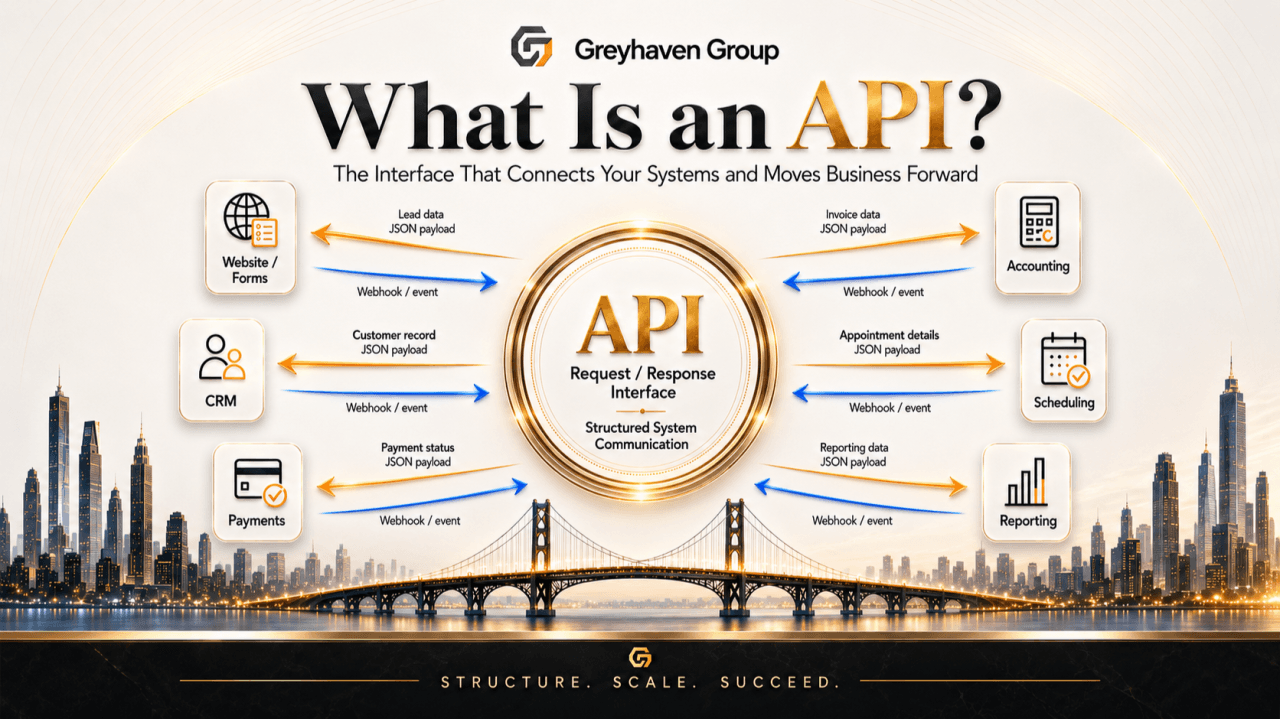
How APIs help business systems communicate — and why disconnected tools often turn employees into the communication layer.
APIs are one of the reasons modern business systems can work together.
In our last post, we discussed why automation is not the same thing as infrastructure. Automation can move work forward, but the business still needs a clear foundation for where information lives, how it moves, and which systems are responsible for each step. This is where APIs become important.
An API, or Application Programming Interface, is a way for one software system to communicate with another. For a business owner, the technical definition matters less than the practical result: APIs help information move between tools without requiring a person to manually carry it from one place to another.
One way to think about an API is like a translator between systems. Your website, CRM, payment processor, accounting software, scheduling platform, and reporting tools may all speak different languages. An API helps those systems exchange information in a way each one can understand.
It can also be useful to think of an API like a bridge. Without a bridge, people have to carry information across manually. Someone exports a report, copies data into a spreadsheet, checks one system against another, or updates a record by hand. With the right connection in place, information can move more directly from one system to the next.
For example, when a customer fills out a form on your website, an API can help send that information into your CRM. When a payment is processed, an API can help connect that transaction to an invoice, order, customer record, or reporting system. When an appointment is booked, an API can help update the schedule, notify the team, or trigger the next step in the workflow.
Without those connections, employees often become the bridge between tools. They are the ones downloading, copying, checking, updating, reconciling, and confirming information that should be moving through the business more cleanly.
That may work when the business is smaller, but it becomes harder to manage as volume increases. More customers create more records. More payments create more transactions to reconcile. More platforms create more places for information to become inconsistent.
APIs do not automatically create strong infrastructure. A business still needs to decide which systems should communicate, what information should move, which platform owns the reliable record, and what should happen when something fails.
But when APIs are used correctly, they help turn separate tools into a more connected operating environment. They reduce manual work, improve consistency, and help the business move information with less friction.
For business owners, the point is not to understand APIs like a developer. The point is to understand that when systems cannot communicate, the team usually becomes the communication layer. And as the business grows, that becomes expensive.
Originally published by Greyhaven Group on LinkedIn.
View on LinkedInStart a Project