Business InfrastructureJune 15, 20267 min read
What a Single Source of Truth Means
Why growing businesses need clarity on which system owns each critical record — and why that does not mean forcing everything into one platform.
Why growing businesses need clarity on which system owns each critical record — and why that does not mean forcing everything into one platform.
In our last article, we discussed the cost of data living in too many places. When customer records, payments, invoices, appointments, orders, reports, documents, and operational notes all live across different systems, a business can lose visibility even if it has plenty of software in place.
The issue is not always that the company lacks tools. Many times, the company has a CRM, payment processor, accounting platform, scheduling tool, website, project management system, reporting dashboard, and spreadsheets. The real issue is that no one is fully clear on which system should be trusted.
This is where the idea of a single source of truth becomes important.
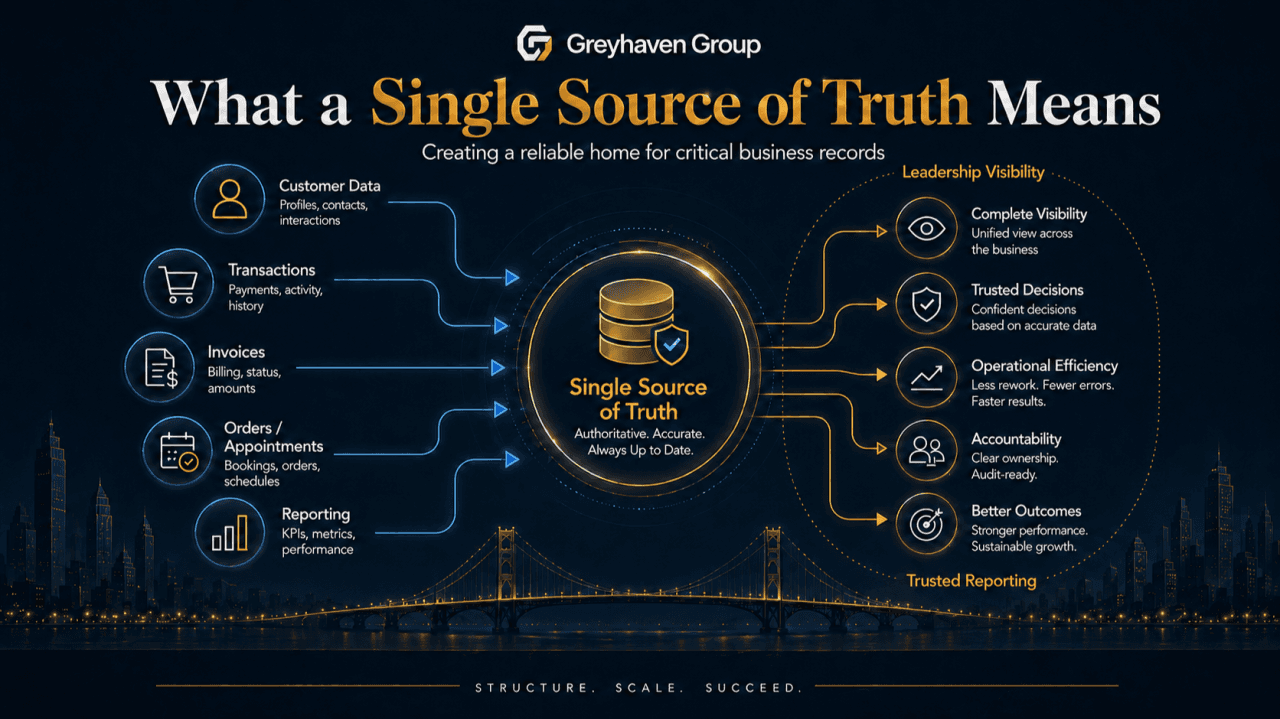
A single source of truth means the business knows where the reliable record lives for important information. It does not mean every piece of data has to live inside one platform. That is a common misunderstanding. Most growing businesses will continue using multiple systems because different systems serve different roles.
For example, a CRM may own the customer record. A payment processor may own the transaction record. Accounting software may own the invoice record. A scheduling platform may own the appointment record. A project management tool may own task or fulfillment status. A reporting dashboard may bring key information together for leadership.
The goal is not to force every department, workflow, or record into one tool. The goal is to create clarity around which system is responsible for the accurate version of each critical record.
Without that clarity, confusion starts to build. A customer's email address may be updated in one system but not another. A payment may be collected, but the invoice status may not reflect it. A lead may be marked active in the CRM while someone else's spreadsheet says it has already gone cold. A report may show one revenue number while accounting shows another.
When that happens, the team has to stop and figure out what is true. That is not a reliable operating system. That is people filling the gaps between disconnected tools.
A single source of truth reduces that dependency by giving the business clear answers to important questions: Where do we look for the correct customer record? Where do we confirm whether a payment was completed? Where do we check whether an invoice is open or paid? Where do we see the status of an order, project, or appointment? Where does leadership go to understand what is happening in the business?
These are not only technical questions. They are operating questions.
A business can have modern software and still lack a single source of truth. If every department keeps its own version of the data, leadership does not have one clear view of the company. It has multiple partial views. That slows down decisions and creates avoidable work because teams spend time checking, copying, reconciling, and explaining information instead of using that information to move the business forward.
A single source of truth requires the business to define which system owns each important record, how that record gets updated, which tools can access it, and what happens when information changes. If the CRM owns the customer record, customer updates should either happen there first or flow back there reliably. If accounting owns invoice status, other systems should not create conflicting versions of that status. If the payment processor owns transaction data, reports should clearly connect those transactions to the right customer, order, or invoice.
The more a business grows, the more important this becomes. At a smaller stage, the owner or team may be able to remember what is accurate. They may know which spreadsheet is current, which platform is outdated, and which report needs to be adjusted manually. But as volume increases, that way of operating becomes risky.
Growth adds pressure: more customers create more records, more transactions create more reconciliation, more employees create more handoffs, more platforms create more places for information to drift, and more reporting needs create more chances for conflicting numbers.
A single source of truth helps prevent that drift. It does not remove the need for multiple systems. It gives those systems structure. When a business knows where the truth lives, teams can move faster. Reports become easier to trust. Customers receive more consistent service. Leadership can make decisions with more confidence.
The value is not only cleaner data. The value is a business that is easier to manage.
Originally published by Greyhaven Group on LinkedIn.
View on LinkedInStart a Project