Business InfrastructureJune 12, 20266 min read
The Cost of Data Living in Too Many Places
Why scattered customer, payment, and operational data creates visibility problems, duplicate work, and dependency on people who know where everything lives.
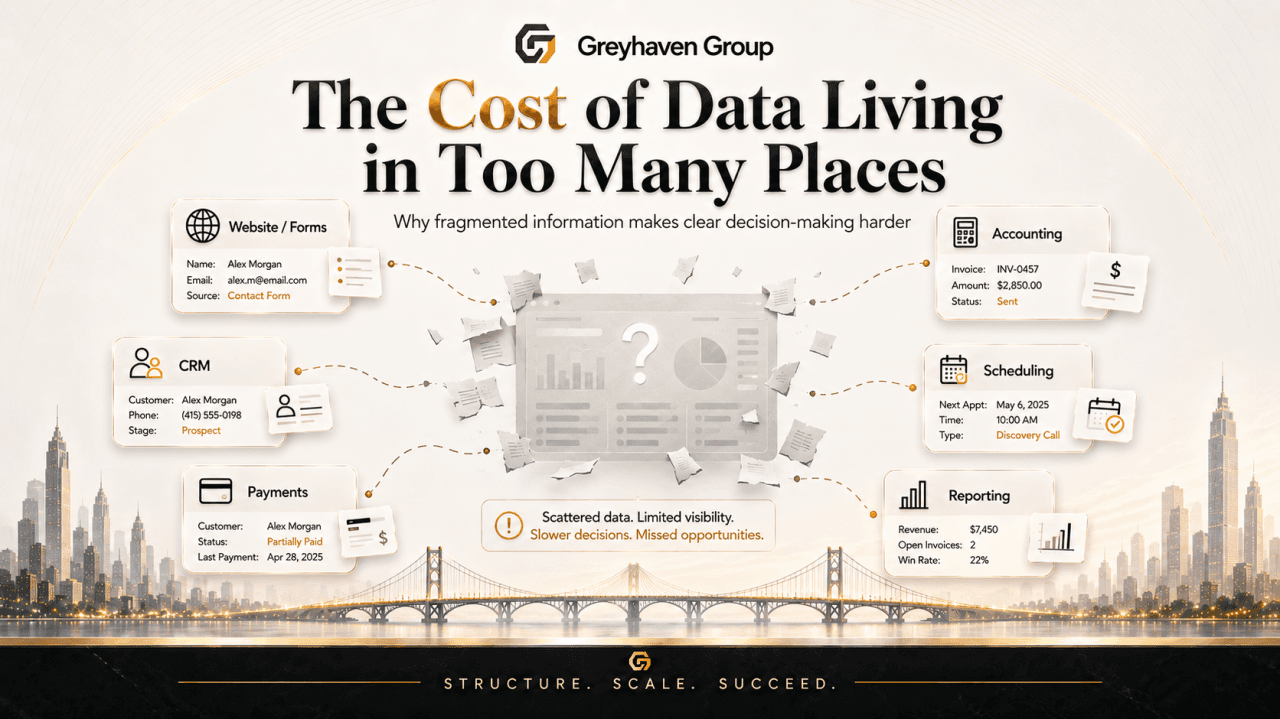
Why scattered customer, payment, and operational data creates visibility problems, duplicate work, and dependency on people who know where everything lives.
In our last article, we discussed APIs and why system communication matters. APIs help software platforms exchange information so that a business does not have to rely on people manually carrying data from one tool to another.
But when systems are not clearly connected, important business data often ends up living in too many places. This is one of the most common infrastructure problems inside growing companies.
A business may have customer records in a CRM, payments in Stripe, Square, or another processor, invoices in accounting software, appointments in a scheduling platform, orders inside Shopify or Wix, documents in shared folders, communication in email or Slack, and operational tracking inside spreadsheets.
Each tool may serve a useful purpose. The problem begins when no one is fully clear on which system owns the reliable record.
For example, the CRM may show one customer status, while the payment processor shows a different transaction history. The accounting software may show an invoice as unpaid, while someone on the team knows the payment was collected. A spreadsheet may contain updated operational notes that never made it back into the main system.
In those situations, the business does not have a technology problem only. It has a visibility problem.
Leadership cannot make clean decisions if the information behind those decisions is fragmented. Teams cannot operate efficiently if they have to check several platforms before knowing what is true. Reporting becomes slower when numbers have to be exported, cleaned, compared, and explained manually.
This is where scattered data starts to create real cost. It creates duplicate work because employees enter the same information more than once. It creates delays because reports require manual cleanup before they can be trusted. It creates mistakes because one system may be updated while another is not. It creates missed handoffs because important details may live in a spreadsheet, inbox, note, or conversation instead of the system the team actually uses.
It also creates dependency on specific people. When data is scattered, the process often depends on the employee who knows where everything is. That person knows which spreadsheet matters, which system is outdated, which report needs to be adjusted, and which number leadership should actually trust.
That may work for a period of time, but it becomes risky as the business grows. The larger the company becomes, the more important it is to define where information belongs.
A growing business needs to understand: Where does customer information live? Where do payment records live? Where do orders, appointments, or projects live? Which system owns the accurate status? Which reports should leadership trust? How does information move from one platform to another?
These questions are part of business infrastructure. The goal is not always to force every piece of data into one platform. In many companies, different systems will continue to handle different parts of the operation. The goal is to create clarity.
A business should know which system owns each critical record, how that information is updated, and how leadership can access a reliable view of the company without manually reconstructing the truth every time. When data lives in too many places, the business becomes harder to manage. When data ownership is clear, the company can operate with more confidence.
Originally published by Greyhaven Group on LinkedIn.
View on LinkedInStart a Project